A down-to-earth, hopeful walk across the real China – one small-town conversation at a time
Review by John Ross
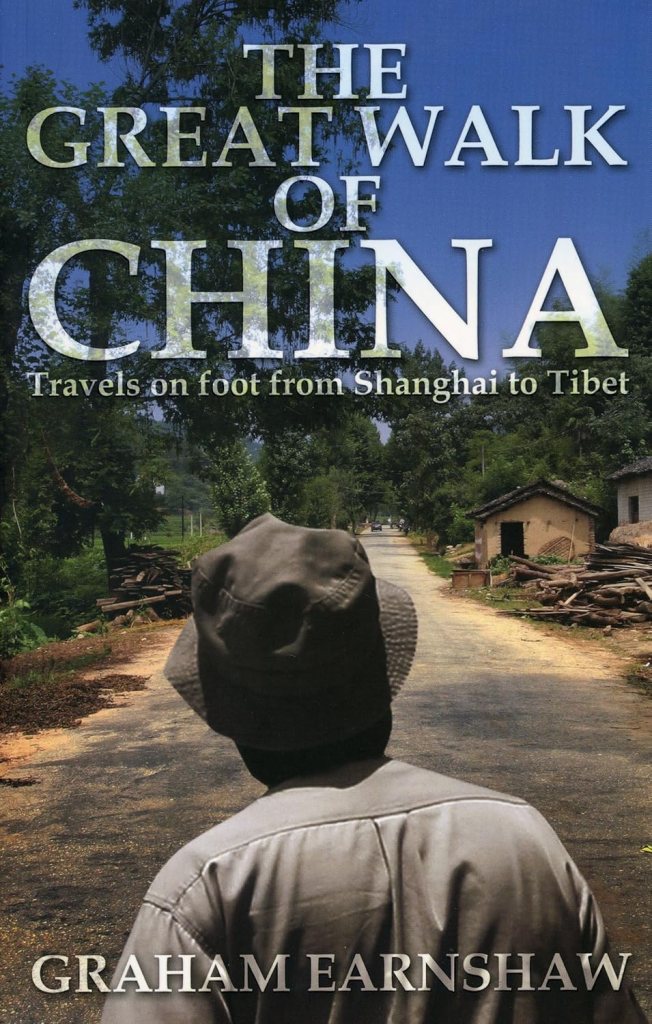
- Author: Graham Earnshaw
- Book First Published: 2010
- Publisher: Blacksmith Books
- Rating: ★★★
How our ratings work:
★★★ – Loved it. Highly recommended. Transcends interest in the location alone
★★☆ – Liked it. Recommended, especially if you’re interested in the location
★☆☆ – Didn’t like it. But may still appeal to those interested in the location
The Gist
Inspired by Edwin Dingle’s 1909 Across China on Foot (and thinking “I can do better than that!”), veteran China hand Graham Earnshaw embarks on his own modern version of the journey. He covered more than 2,000 kilometers over nearly six years, walking at a leisurely pace from Shanghai to Sichuan.
It was “simply a series of strolls through the countryside,” as he puts it, and also a series of chats with farmers, pensioners, and curious locals. His fluent Mandarin and genial, middle-aged presence made him an unintimidating figure. The result on paper is a readable, richly human travelogue that reveals a peaceful, rapidly changing Chinese heartland.
The Guts
Rather than a continuous trek, The Great Walk of China is a series of linked walking journeys. From Shanghai, which he calls home, he passed through the provinces of Jiangsu, Zhejiang, Anhui, Hubei and Sichuan, (and the province-sized municipality of Chongqing).
Earnshaw always started from where he last left off, carrying only a light pack and staying in local inns and hotels. This episodic structure, surprisingly seamless in the telling, allows for a fresh and upbeat tone throughout. Not being worn down by the drudgery of walking day after day and fielding the same questions and reactions (“from England…..the Opium Wars”), he remains refreshed and in good temper, eager for conversations.
Unlike many long-distance walkers, Earnshaw didn’t care about knocking off maximum mileage; instead, he clocked up a relatively modest fifteen or more kilometers a day, depending on how much time he spent chatting.
It’s these interactions which are the heart of the book. One standout encounter is with Mr. Zhou, an aging intellectual from Hubei, whose life was upended by the Communist Party. “I have waited decades for this,” Zhou tells Earnshaw, thrilled at the chance to speak freely with an educated outsider. Such moments elevate the book beyond an account of a walk.
The China which Earnshaw was walking through was more prosperous and open than ever, the atmosphere more optimistic than what one would experience today. He says the prevailing feel of the countryside was one of peace:
“Possibly the most peaceful that it had been in several hundred years. The people of the villages had the basics of life: they had readily available food, were well dressed in simple but warm clothes and even the most basic mud-brick farmhouse had satellite television.”
Why read The Great Walk of China?
The Great Walk of China captures a China rarely seen in the headlines: everyday life far from the big cities. We get slow travel through a landscape and society in the company of a curious and knowledgeable guide.
Earnshaw’s style is accessible and without self-importance. And he avoids a pitfall of many accounts describing long-distance walks. Walk-based travelogues, despite promising so much, are prone to plodding repetition of distances covered and milestones crossed off.
Earnshaw visited towns and cities you’ve never heard of, and this highlights an interesting aspect of the trip; in many ways, his walk down the back roads of China’s fly-over territory was closer to old-fashioned exploring than would be visiting wilder, more exotic areas such as western Yunnan. For most of the people he encountered in the countryside, the author says he was “the first non-Chinese person they have ever seen, let alone spoken to.”
The Great Walk of China is one of the most sympathetic, non-sensationalized works I’ve read about modern China. It provides a heart-warming affirmation of that important insight which thoughtful travel gives us; people around the world are basically the same and essentially good.
John Ross, a New Zealander living in Taiwan, is the author of Formosan Odyssey, You Don’t Know China, and Taiwan in 100 Books.
He is also the co-founder of Camphor Press and Plum Rain Press. John co-hosts Formosa Files, a podcast on the history of Taiwan, and the Bookish Asia podcast.
Support this site by buying his books.
 The Travel Memoir Review
Leave a comment