An intimate portrait of an island, chronicling a vanishing way of life, and showing a possible future direction for travel writing
Review by John Ross
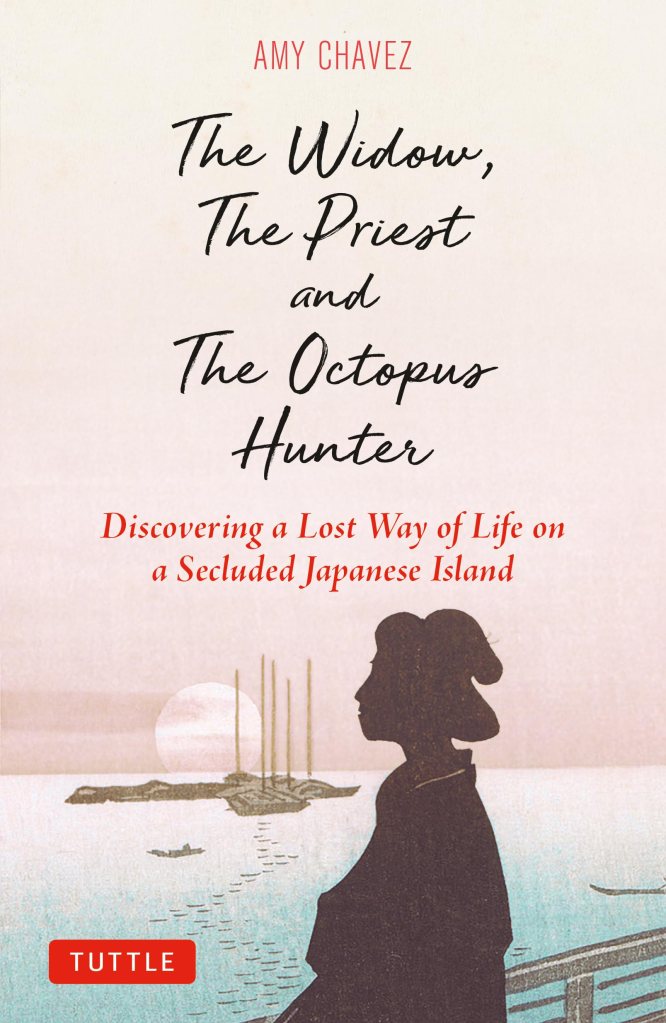
- Author: Amy Chavez
- Book First Published: 2021
- Publisher: Tuttle
- Rating: ★★★
How our ratings work:
★★★ – Loved it. Highly recommended. Transcends interest in the location alone
★★☆ – Liked it. Recommended, especially if you’re interested in the location
★☆☆ – Didn’t like it. But may still appeal to those interested in the location
The Gist
Veteran Japan writer Amy Chavez has lived on Shiraishi Island, a tiny outpost in the Seto Inland Sea, for over 25 years. In The Widow, The Priest and The Octopus Hunter, she draws on her long local knowledge to describe disappearing customs, interviewing elderly islanders and weaving their memories into a moving collective story.
Chavez first moved to Japan in 1993 to take up a university teaching position in Okayama, a city on the Seto Inland Sea halfway between Hiroshima and Osaka. After four years of city life, she felt the lure of the countryside, “a yearning for something more soul-enriching.” Chavez went looking for a new home offering flavors of yesteryear, somewhere she could encounter superstitions, festivals and folklore, and be closer to nature. She found all that on the tiny island of Shiraishi (White Rock).
The Guts
Chavez took up residence on Shiraishi Island, renting a house from an elderly woman named Eiko, who was leaving the island and also leaving many of her possessions behind. There was some mystery about those items and her life, and Eiko’s story provides a thread running through the book. In common with the feelings of many islanders, Eiko’s family mementos were not especially treasured. In fact, islanders are rather casual about old belongings. They throw them out, or they burn them:
“Twice a year the local temple holds a Buddhist goma fire ceremony, believed to have a spiritual cleansing effect, where people can burn items too sentimental to throw out with the dirty garbage. Photos, letters and talismans will be blessed by a yamabushi mountain ascetic priest before they are turned to smoke and journey up to the gods for safekeeping.”
Eiko’s story was a catalyst for Amy’s book as an act of preservation and remembrance (and to satisfy her own curiosity). During the course of a year she interviewed dozens of islanders and transcribed the recorded conversations. The result is over thirty fascinating, intimate portraits. We get to meet the Pufferfish Widow, the Octopus Hunter, the Tombstone Maker’s Wife, a Buddhist Priest, the Cargo Ship Captain, the Stonecutter, and many others.
These names are not just memorable chapter titles, or a clever way to distinguish similar surnames, but how the islanders are known by each other. These informal names also reveal the important industries of the island: fishing, quarrying, shipping, and tourism – or, more accurately, formerly important industries, as they have all been on the wane for many decades. Today the main source of income is pensions.
Why read The Widow, The Priest and The Octopus Hunter?
This is a beautifully crafted work. The writing is understated and evocative, the structure smart, and the sense of melancholy is balanced with humor and affection. That sadness comes partly from the long shadows of war but also from the fact that the island’s rapidly-aging community will all but disappear within a generation.
“When these children of the early twentieth century pass away, they will not be replaced by sons, daughters or grandchildren because they have all moved to the cities. Only the boulders and mountains on this island will be witness to what once was.”
Shiraishi’s population was about two thousand in the 1960s, but had fallen to only 430 at the time of writing (2021), with “most of them elderly, some well into their nineties.” The island’s elementary school had closed three years before. There was still a junior high school but when the author spoke to both of the students (yes, the school had only two students) it was weeks away from closing.
The book’s hyper-local focus is an antidote to the empty calories of much modern travel and travel writing. I hope such deep immersions will become a trend in the coming years.
John Ross, a New Zealander living in Taiwan, is the author of Formosan Odyssey, You Don’t Know China, and Taiwan in 100 Books.
He is also the co-founder of Camphor Press and Plum Rain Press. John co-hosts Formosa Files, a podcast on the history of Taiwan, and the Bookish Asia podcast.
Support this site by buying his books.
 The Travel Memoir Review
Leave a comment