A fascinating blend of travel and history that uncovers Britain’s hidden fingerprints across
Argentina, Uruguay, and Chile.
Review by Patricia Cuni
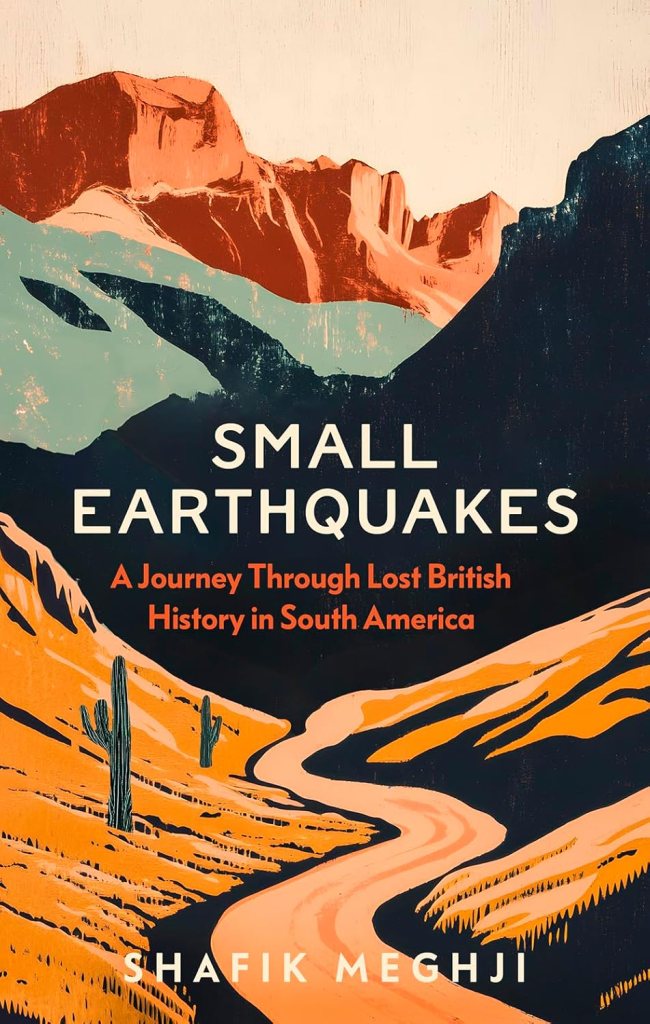
- Author: Shafik Meghji
- Book First Published: 2025
- Publisher: C. Hurst & Co. (Publishers) Ltd.
- Rating: ★★★
How our ratings work:
★★★ – Loved it. Highly recommended. Transcends interest in the location alone
★★☆ -Liked it. Recommended, especially if you’re interested in the location
★☆☆ -Didn’t like it. But may still appeal to those interested in the location
The Gist
In Small Earthquakes: A Journey Through Lost British History in South America, travel writer and journalist Shafik Meghji takes readers on a vivid journey across Argentina, Uruguay, and Chile, exploring the forgotten or overlooked traces of Britain’s empire.
Meghji, who has spent years researching and traveling in the region, weaves together his personal experiences on the ground with a meticulously researched historical narrative. From the streets of Buenos Aires to the windswept landscapes of Patagonia, from Welsh colonies in Chubut to the desolate ghost towns of the Atacama, he shows how Britain’s presence in South America extended far beyond the Falklands and football rivalries.
The book is part travelogue, part historical investigation, and part meditation on the legacies of colonialism. Meghji’s writing thrives on contrasts: bustling cafes against empty pampas, Welsh hymns in the Patagonian cold, and British-built railways threading through Indigenous land. It’s a story that reveals how empire shaped not only landscapes and cities but also the lives of people—descendants of settlers, Indigenous communities, and those who resisted foreign control.
The Guts
What makes Small Earthquakes so engaging is its ability to shift seamlessly between the author’s travels and the layered histories of the places he visits. Meghji doesn’t just describe the streets, bars, and museums of Buenos Aires; he shows how their foundations are steeped in the often uneasy legacy of British influence. His meeting with Andrew Graham-Yooll, former editor of the Buenos Aires Herald, anchors the book’s opening and sets the tone for a narrative where memory and identity are never far from view.
Among the stories, I was captivated by the life of Robert Bontine Cunninghame Graham—the so-called “gaucho laird,” whom James Jauncey described as a “fantastic combination of Don Quixote and Sir Gawain, Indiana Jones and the Lone Ranger”. A Scottish aristocrat turned cowboy, socialist MP, and fierce anti-imperialist, his adventures exemplify the entangled relationship between Britain and South America.
Equally intriguing was the tale of Y Wladfa, the Welsh colony established in Patagonia in 1865 by settlers who arrived aboard the Mimosa. I had no idea the Welsh ever attempted to found a colony in South America, and Meghji paints a poignant picture of their struggles, their coexistence with Indigenous peoples, and their cultural legacy that still lingers in the region.
Other chapters deal with darker episodes, such as the so-called “Conquest of the Desert,” when Argentina expanded into Patagonia, eradicating Indigenous groups like the Tehuelche, Selk’nam, Yagan, and Kawésqar—an atrocity that took place long after independence from Spain, but under the shadow of British influence. Particularly harrowing is the account of Rapa Nui (Easter Island), whose people were kidnapped in the 19th century and sent to Peru to toil in guano mines.
As Meghji writes:
“Everywhere I went, I stumbled upon forgotten stories and unexpected connections between Britain and South America, a history I wasn’t taught about in school and didn’t see represented in the media or popular culture”.
That quote encapsulates the book’s strength: revealing a history hiding in plain sight.
Why Read Small Earthquakes?
This is not just a book about the past; it’s deeply relevant to today’s readers. The long shadow of empire still shapes politics, economies, and identities across South America, and Meghji demonstrates that Britain’s role there was far more significant than most people realize. Like Sathnam Sanghera’s Empireland or Caroline Elkins’ Legacy of Violence, this book forces us to reconsider the extent of Britain’s global reach and its enduring consequences.
Personally, as a Spaniard, I learned a huge amount about the history of Argentina, Chile, and Uruguay after they broke free from Spain. What struck me most was not only how Britain inserted itself into these young nations, but also the complicity of the UK in supporting dictatorships like Pinochet’s in Chile—going so far as to grant asylum to him in Britain. These stories are uncomfortable but vital to confront.
Stylistically, I loved how Small Earthquakes marries vivid travel writing with rigorous historical research. One moment Meghji is describing the atmosphere in a San Telmo café, and the next he’s unpacking the financial crisis sparked by the Baring Brothers bank in Buenos Aires. The book is rich with quotes, anecdotes, and testimonies from both historians and local voices, making it immersive yet scholarly.
I’d recommend Small Earthquakes to anyone interested in South American history, the legacies of empire, or simply a beautifully written travel-history hybrid. It’s a rewarding read for those who, like me, enjoy discovering hidden histories and seeing the world’s past through a fresh lens.

Patricia Cuni is a Spanish journalist and travel writer based in Edinburgh.
She runs Mad About Travel, sharing Scotland’s hidden gems with a Spanish-speaking audience. Twice named among Scotland’s Top 100 Women in Tourism, she is Marketing Manager at The Real Mary King’s Close.
 The Travel Memoir Review
Leave a comment