A smart, evocative, far-flung memoir of travel and life by one of America’s great unsung writers.
Review by Thomas Swick
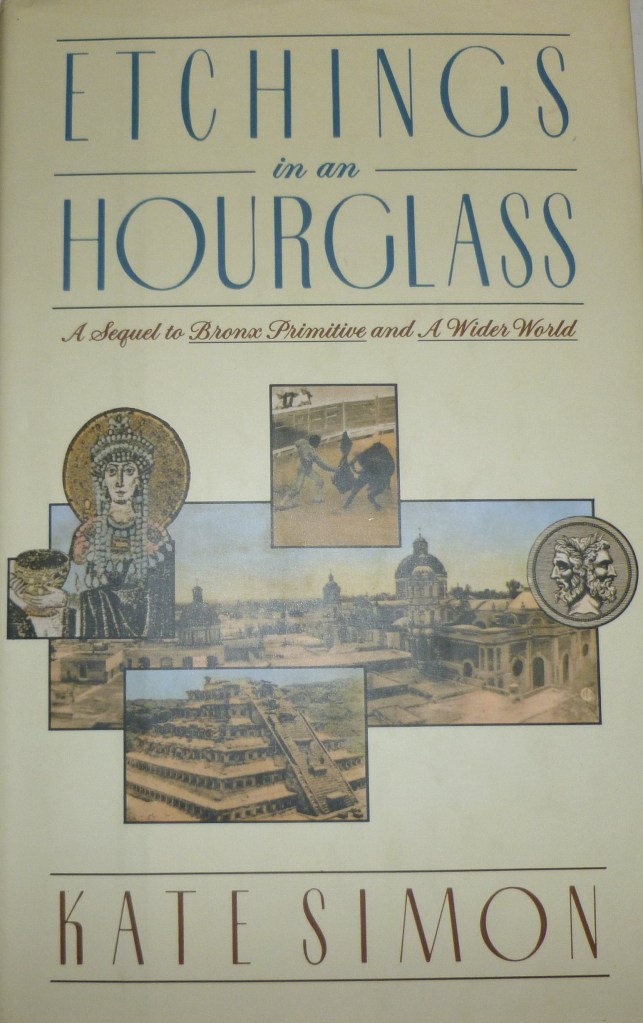
- Author: Kate Simon
- Book First Published: 1990
- Publisher: Harper & Row
- Rating: ★★★
How our ratings work:
★★★ – Loved it. Highly recommended. Transcends interest in the location alone
★★☆ – Liked it. Recommended, especially if you’re interested in the location
★☆☆ – Didn’t like it. But may still appeal to those interested in the location
The Gist
Kate Simon is almost forgotten today, sadly, though in the ’70s and ’80s she was well-known for her “uncommon guidebooks” – which mixed practical information with insightful essays – and her literary memoirs: Bronx Primitive and A Wider World.
Etchings in an Hourglass is the concluding volume in the trilogy, and the one most focused on her travels. Simon enjoyed a colorful, peripatetic life – in one section she describes her lodgings in a variety of lands – and had a special fondness for France, Italy, and Mexico. She brings to these countries, and many others, a keen, well-trained eye not only for the art – in the museums as well as in the streets – but also for the people – locals and fellow travelers – met along the way. And she paints vivid, unsentimental portraits of family and friends from her not-always-easy life in New York City.
The Guts
The book is a grab bag of recollections, vignettes, sketches, reflections – all the scenes and moments that stood out from half a century of travel. There is no narrative to speak of, though one gets a palpable sense of time’s unstoppable march, and no chronological or thematic arrangement of the chapters. Simon begins with an account of an illness in the Yucatán, moves on to an impressionistic study of a former lover in New York, and then takes us to India and, in the same chapter, Japan. The next chapter, “Est-ce Que Vous Êtes Juive?” – Simon was Jewish, and came to the U.S. from Poland at the age of four – collects instances of anti-Semitism, subtle and not so.
Linking everything together is the author’s voice: intelligent, cultured, wise, tolerant, and brave in the face of heartache and tragedy. Foreign words, especially French ones, appear without translation, and classical references abound. “Love,” she writes, “had the head of Janus”; later she refers to the “Caliban side of memory.” Reading Simon is as much an education as it is a pleasure.
She possessed a deep knowledge and love of art – tossing off the names of paintings, temples, sonatas as if they were old friends – yet was even more fascinated by the people, some of them old friends, who, inevitably, she had to keep out of her guidebooks. The “Flight to Mexico” chapter is made memorable by an eccentric Scandinavian-Chinese couple who befriended her in Oaxaca, and her time in Rome is sweetened by her alliance with an uneducated, streetwise operator who was also “my latter-day impetuous, unwise, generous, grand Renaissance duke.” The book is sprinkled with other, less platonic relationships.
Simon is as insightful about herself, and her unconventional life, as she is about others. Heading off on another long sojourn, with no fixed address, she reflects:
“No matter that I did or didn’t have the streets, the numbers. I was I and remained I; gathered together, very rarely dissolved or lost, firm in my anticipation of wonderful things to see and learn, to nestle comfortably in almost any civilization.”
Why read Etchings in an Hourglass?
The book is doubly transportive: It describes foreign places and captures a time long before they were crowded with tourists. Cozumel, today a popular stop for cruise ships, appears as “a remote, untouched island village” where Simon spent the better part of a year.
At the same time, you learn about valuable treasures and worthwhile sights to seek out on your next trip to Europe, North Africa, India, or Mexico (she was a guidebook writer after all). But more than that, she was an avid student of human nature, and had the opportunity to observe it in a wide range of settings and situations. So reading her you learn – as from all great writers – about people, their infinitely varied and mysterious ways, and about life.
Finally, there is enormous pleasure to be had in her beautifully rigorous prose. My edition is filled with underlined sentences. The only downside of the book is that it will make your own life seem very dull.

Thomas Swick was the travel editor of the South Florida Sun-Sentinel for 19 years and is the author of four books, including: The Joys of Travel and, most recently, the memoir Falling into Place: A Story of Love, Poland, and the Making of a Travel Writer.
 The Travel Memoir Review
Leave a comment