An effortless read of an ambitious journey through the tangled histories and simmering resentments of East Asia.
Review by John Ross
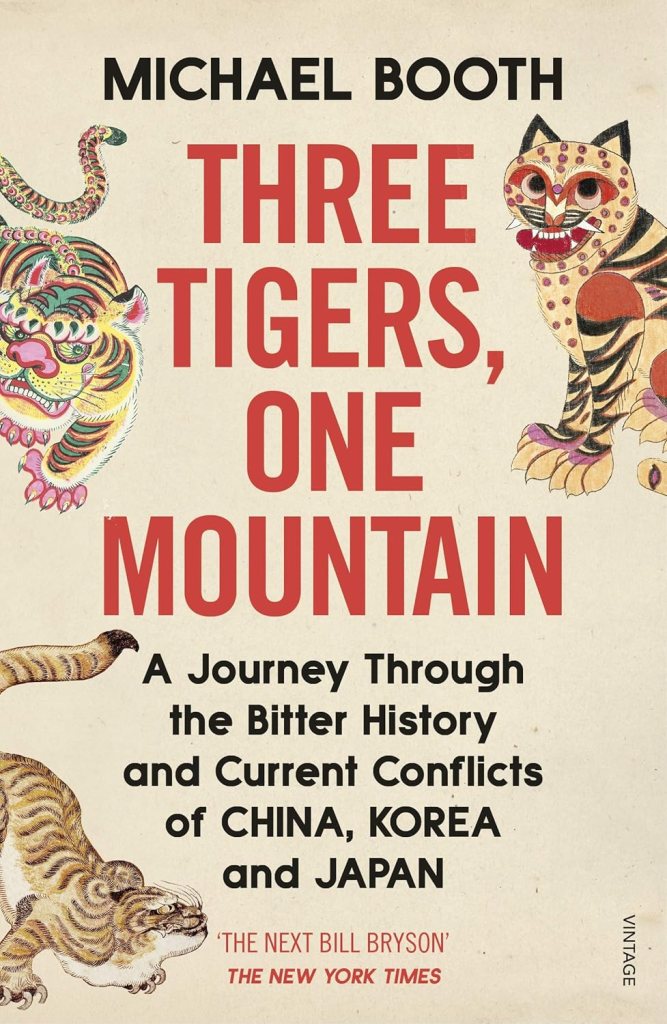
- Author: Michael Booth
- Book First Published: 2020
- Publisher: Jonathan Cape
- Rating: ★★★
How our ratings work:
★★★ – Loved it. Highly recommended. Transcends interest in the location alone
★★☆ – Liked it. Recommended, especially if you’re interested in the location
★☆☆ – Didn’t like it. But may still appeal to those interested in the location
The Gist
Michael Booth, known for his bestselling The Almost Nearly Perfect People: Behind the Myth of the Scandinavian Utopia (2014), turns his curiosity to the “Three Tigers” of East Asia: Japan, South Korea, and China. The title is a twist on an old Chinese saying that “two tigers cannot share the same mountain.” While the East Asia region shares deep cultural roots – from religion and architecture to the every-day ubiquity of noodles and chopsticks – it is defined by a bitter history that continues to strain relations.
In Three Tigers, One Mountain, Booth visits Japan, South Korea, and China to understand why, unlike European countries which largely managed to move on from World War II, East Asian animosities remain so high. Though he lives in Denmark and doesn’t know the region as intimately as Scandinavia, he did extensive reading and interviewed numerous experts. The result is a winning formula of current affairs, popular history, and travel designed for the general reader.
The Guts
Booth visits Japan first, which he describes as:
“a country which functions better than almost any other in the world on almost every level, from its low crime rates and exemplary public transport to extremely high levels of civic responsibility, not to mention the best service culture you will ever enjoy.”
Japan is clearly Booth’s favorite “tiger” and he has written several food-related books about the country. However, he still calls out its shortcomings, such as the sterile ugliness of the built landscape: in Kyoto, away from its famed architectural gems, he describes:
“the hostile concrete wasteland around the station”
and
“walking for hours along soulless six-lane roads lined with anonymous office buildings and Starbucks coffee shops.”
The narrative shifts to South Korea, where readers learn that it’s not just atrocities from the Japanese colonial era that still rankle with the local population – a deeper resentment stems from the Imjin Wars of the 1590s. This double invasion of Korea by Japan was arguably the world’s biggest war of the 16th century. Booth shows courage in handling the WWII comfort women issue; he gives the hard truth about how the topic is often utilized for political leverage within Korea.
Next, we go to China, where we see how anti-Japanese resentments have been actively maintained by the Chinese Communist Party’s political “patriotic education.” He ends his travels with a brief visit to Taiwan, where Booth believes – mistakenly, I would argue – there is hostility against Koreans.
Why read Three Tigers, One Mountain?
This journalistic travelogue is a well-written, informative, and humorous read. Yes, it has flaws: his take on Taiwan; his impressions sometimes leading to overly broad generalisations; and the occasional overstatement of factual points, such as labeling the First Sino-Japanese War as a “skirmish.”
But the book deserves all three stars for the author’s bravery in tackling difficult subjects and making the case that China and South Korea need to move on. Thankfully, in the six years since the book came out, there’s been a big change in South Korean sentiments toward Japan, especially among the young. Sadly, Beijing continues to be as bellicose as ever.
Booth also deserves great credit for tackling a multi-country book. The majority of travelogues are limited to a particular nation; the books featured on this very website are proof of that. And if another lens is used, it’s almost always to focus in on a province or town. But zooming out for a wider regional view is all too rare, which is a pity, because such books show us important cultural and historic similarities and differences across boundaries. And sometimes it’s just fun to visit more than one country at a time.
John Ross, a New Zealander living in Taiwan, is the author of Formosan Odyssey, You Don’t Know China, and Taiwan in 100 Books.
He is also the co-founder of Camphor Press and Plum Rain Press. John co-hosts Formosa Files, a podcast on the history of Taiwan, and the Bookish Asia podcast.
Support this site by buying his books.
 The Travel Memoir Review
Leave a comment