An inspiring account of rural craftsmanship and Tokyo highlife, as an American journalist transplants and restores an ancient home
Review by Sam Baldwin
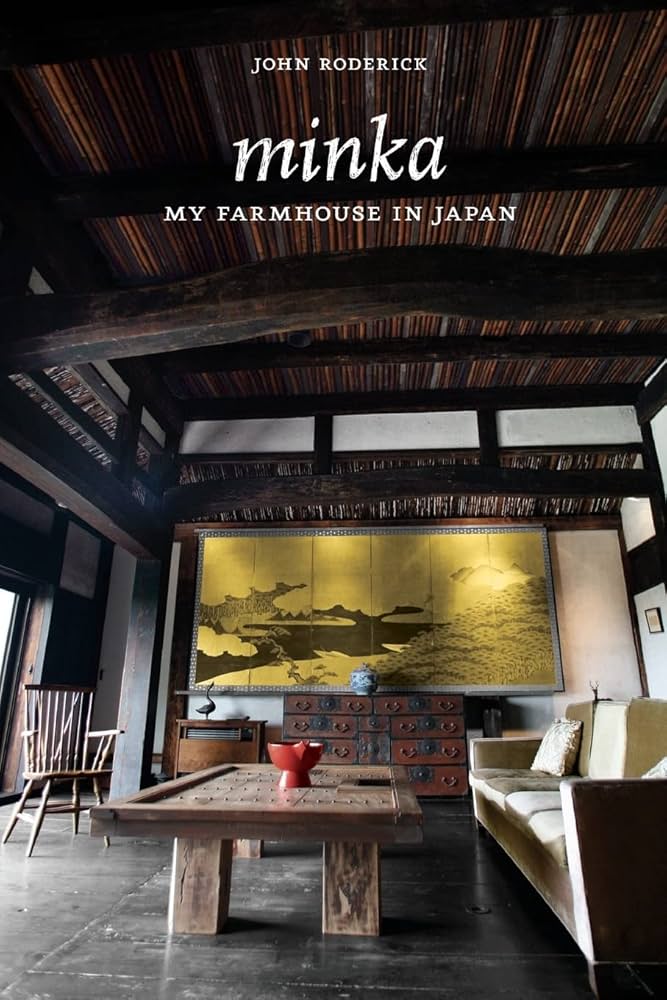
- Author: John Roderick
- Book First Published: 2007
- Publisher: Princeton Architectural Press
- Rating: ★★★
How our ratings work:
★★★ – We loved it. Highly recommended, even if you’re not specifically interested in the location
★★☆ – We liked it. Recommended, especially if you’re interested in the location
★☆☆ – We didn’t like it. But it may still appeal to those interested in the location
The Gist
John Roderick was an American journalist who lived in Japan and worked for the Associated Press from 1959 through to the mid ‘80s. During this time, he acquired a soon-to-be-destroyed minka – a huge, traditional, thatched wooden farmhouse – held together entirely by wooden pegs and ingenious joinery.
This is a book of two halves; the first covers the herculean task of dismantling, transporting and rebuilding this ancient structure. The second shares aspects of Roderick’s life as a journalist working in Tokyo and Asia, the circles he moves in, and the interesting guests he invites to his home.
The Guts
Roderick gets the 250-year-old minka for a pittance as it stands in a village in Fukui prefecture which is soon to be flooded by the construction of a dam. With the help of a family he befriends from neighbouring Gifu prefecture, and in particular, their son Yoshihiro, Roderick has the house painstakingly taken apart, transported to Kamakura, a coastal town close to Tokyo, and rebuilt by Japanese craftsmen on a hill plot overlooking the sea.
Thus we have the material for a wonderful two part story; the quest to move and restore the minka forms the foundation, and once built, it provides the space to host the stories of its visitors, and Roderick’s life in Japan at large.
The book was published by a Princeton Architectural Press and will certainly delight those with an interest in the architecture of these exquisite buildings. With black and white pictures alongside throughout, we get to follow the progress of the project. Transporting the huge wooden beams and reassembling them in the correct order was no mean feat, especially because craftsmen who still possessed the knowledge of such old structures were a dying breed.
But this is no dry architect’s account; Roderick was a people person, who charms and befriends the carpenters and craftsmen, rural folk, few of whom had ever visited Tokyo and were ‘amused and intrigued by foreigners and foreign ways’.
The second half of the book contrasts nicely with the first. As a well-connected journalist, Roderick had access to some members of high society and this gives us insight into such circles, and what working in Tokyo during the ’70s and ’80s was like. Roderick loved hearing people’s stories, and his house is rarely empty. Many esteemed visitors come to admire its mighty dark beams, bamboo ceiling, and sea views, including dignitaries such as Hillary Clinton and George Bush.
Though Roderick was used to jet-setting around the world for work, once the minka is rebuilt, he becomes increasingly attached to his rural retreat:
“When the hurly-burly of today’s world overwhelms me with its news of the never-ending war between good and evil, love and hate, I hobnob with the rustic ghosts of centuries past in my restored old farmhouse on a hill, overlooking Kamakura, the ancient capital of Japan.”
This combination of old and new – something very Japanese in itself – makes Minka a wonderful window into this period. The book bleeds nostalgia and Roderick’s love for his farmhouse, and Japan in general, make him a warm, knowledgeable, and gracious guide.
In 2015, a 15-minute documentary film about the house was made: Minka: A Farmhouse in Japan, a crowdfunded project published by the New York Times. By then, Roderick was literally on his deathbed, so the film focusses on the now very accomplished Yoshihiro, Roderick’s lifelong junior companion and right-hand man, who went on to become an esteemed architect and aficionado of minka houses. It’s a touching and very poignant piece, well worth watching.
Why read Minka: My Farmhouse in Japan?
Fifty years after the events in the book were captured, does Minka: My Farmhouse in Japan still hold up?
It absolutely does; I loved it. A professional writer, Roderick’s prose is beautiful, warm and laced with light humour. It’s a 250-year-old time capsule, within a 1970s’ time capsule; a three-way love story between man, house, and Japan.
I recommend it for anyone with an interest in the people and lifestyle of a lost, rural Japan. Anyone with a love for beautiful old houses and the restoration of them. And there are enough details of the Japan day-to-day of the time, to interest the general Japanophile too.
All in all, Minka is a touching account of a rare life, wistfully and wonderfully told.

Sam Baldwin is the founder of the Travel Memoir Review, and author of:
• For Fukui’s Sake: Two years in rural Japan
• Dormice & Moonshine: Falling for Slovenia
Support this site by buying his books.
*10,000 copies sold*
A fascinating journey and call to action
Mark Hodson, writer, Sunday Times
Charming, funny, insightful, and moving. The perfect book for any Slovenophile
Noah Charney, BBC presenter
A rollicking and very affectionate tour
Steve Fallon, author of Lonely Planet Slovenia
 The Travel Memoir Review
Leave a comment