A down-to-earth account of a young journalist in Yangon as Myanmar briefly opened its doors to the world.
Review by John Ross
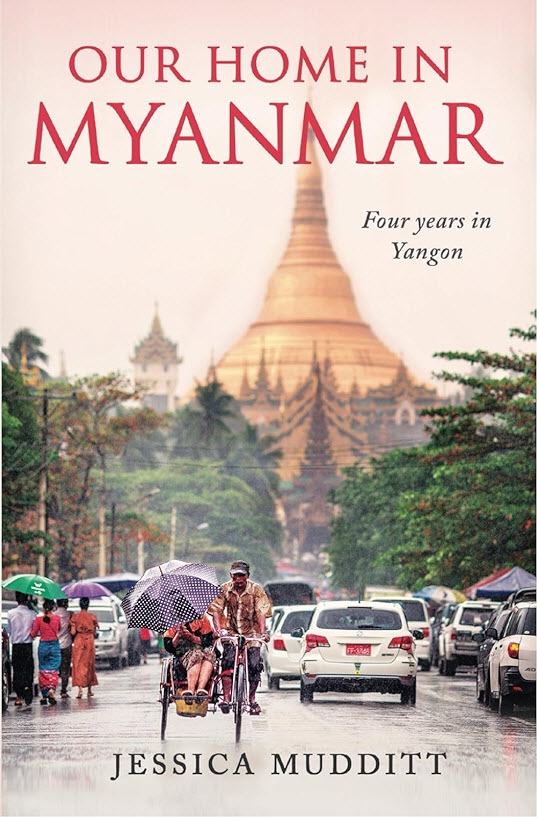
- Author: Jessica Mudditt
- Book First Published: 2021
- Publisher: Independently Published
- Rating: ★★★
How our ratings work:
★★★ – Loved it. Highly recommended. Transcends interest in the location alone
★★☆ – Liked it. Recommended, especially if you’re interested in the location
★☆☆ – Didn’t like it. But may still appeal to those interested in the location
The Gist
In Our Home in Myanmar: Four Years in Yangon, Australian journalist Jessica Mudditt recounts her time living and working in Myanmar between 2012 and 2016, years that marked the country’s tentative shift from dictatorship to democracy. Mudditt worked at The Myanmar Times, freelanced, and later took on projects with the British embassy and the United Nations.
The memoir blends human-interest storytelling with first-hand observation, capturing both the optimism and the unease of Myanmar’s opening years. She takes readers from the newsroom to embassy cocktail parties, offering a rare outsider’s view of the country and one with a special insight.
Mudditt, being married to a Bangladeshi, meant that she saw up close the rise of xenophobia and anti-Muslim sentiment. In the border area with Bangladesh, a Muslim minority known as the Rohingya were being persecuted; in Yangon, her husband was encountering racist abuse and treatment, along with visa hassles.
The Guts
The story begins with Mudditt’s arrival in Yangon to take up a sub-editor position at The Myanmar Times. Mudditt is honest about the steep learning curve she faces. She berates herself for a piece she submitted to the editor with various ethnic groups (of which there are well over a hundred) erroneously named:
“I muddled up Kayin and Kayah and omitted Kachin altogether, not realising it was something different. On top of that, I’d given the male honorific ‘U’ to a female speaker instead of ‘Daw’, as I hadn’t realised she was a woman.”
Not being a Myanmar specialist, Mudditt’s newspaper writing was focused more on human-interest features – subjects like the hair trade (yes, a major export) and animal shelters.
When she’s later fired, new paths open up, including a surreal stint editing the government-run propaganda paper Global New Light of Myanmar. Alongside the narrative arcs of Mudditt going from stumbling scribe to successful media professional, and from Myanmar newbie to expat old hand, is that of the country opening up and becoming freer, culminating in an election in 2015.
The day after the election she wrote a “Dawn of a New Era” article in The Global New Light of Myanmar, but the era would be short-lived. In February 2021, as Mudditt was writing the final chapter of her book, the military seized power, unwilling to see the winners of the 2020 election sworn in. As Mudditt writes in the epilogue:
“Myanmar’s sudden return to a dictatorship means that I have inadvertently written a history book. It documents a brief window of time when the country opened up to the world and embraced democracy.”
Why read Our Home in Myanmar?
The memoir is an accessible introduction to Myanmar and a candid behind-the-scenes look at journalism in a developing country. When it comes to memoirs, journalists have several advantages. Their work brings them into contact with locals from a wide cross-section of society, and with fellow journalists who are often colorful characters.
Journalists also have a lot of previously written material to draw on, and things they’ve wanted to say but been unable to because of length constraints or censorship issues. So, as you’d expect from a working writer, the writing itself in Our Home in Myanmar is good, but not memorably so. What makes it shine is the author herself; she’s big-hearted, down-to-earth, and likeable – such as when admitting to being “templed out” at the historical wonder of Bagan.
Another winning factor I think is that four years is the sweet spot span of foreign residence for a book; perfect in terms of knowing too little and knowing too much. Four years gives you enough material and knowledge, and enough of a narrative timeline, yet you retain fresh memories of all those new flavors of discovery and the frustrations of culture shock.
John Ross, a New Zealander living in Taiwan, is the author of Formosan Odyssey, You Don’t Know China, and Taiwan in 100 Books.
He is also the co-founder of Camphor Press and Plum Rain Press. John co-hosts Formosa Files, a podcast on the history of Taiwan, and the Bookish Asia podcast.
Support this site by buying his books.
 The Travel Memoir Review
Leave a comment