A richly layered journey through Bolivia that blends travel writing, deep history, and urgent reflections on extraction, identity, and survival
Review by Patricia Cuni
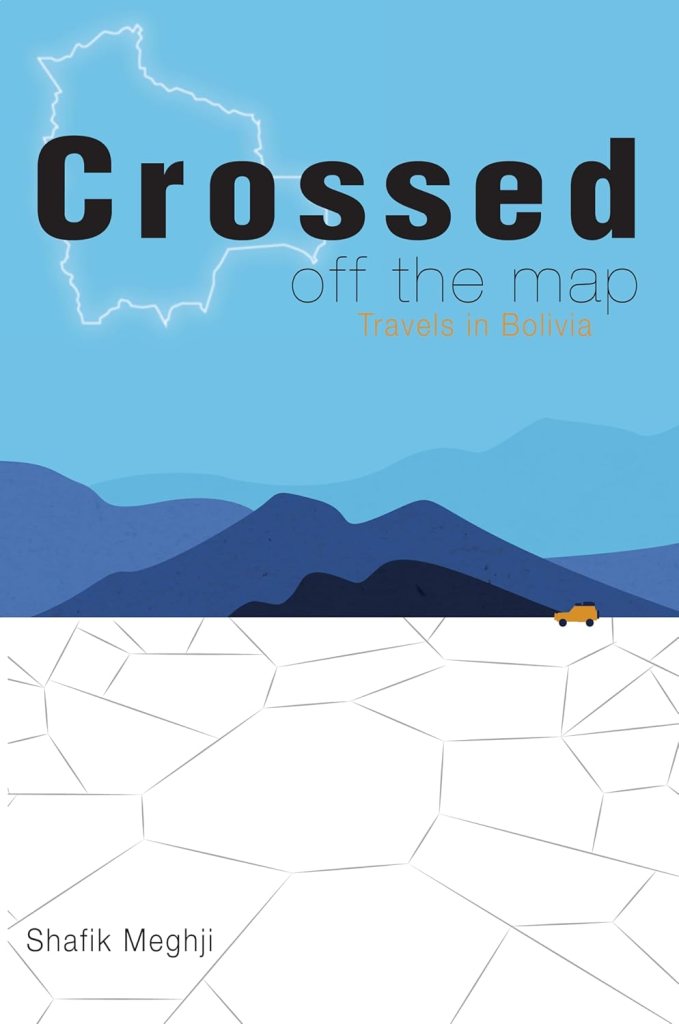
- Author: Shafik Meghji
- Book First Published: 2022
- Publisher: Practical Action Publishing Ltd & Latin American Bureau
- Rating: ★★★
How our ratings work:
★★★ – Loved it. Highly recommended. Transcends interest in the location alone
★★☆ – Liked it. Recommended, especially if you’re interested in the location
★☆☆ – Didn’t like it. But may still appeal to those interested in the location
The Gist
In Crossed Off the Map: Travels in Bolivia, Shafik Meghji sets out to explore a country that has long been misunderstood, marginalised, or reduced to clichés. This is the second book by Meghji that I’ve read, and it further confirms him as an exceptional travel writer with a rare ability to combine vivid, ground-level storytelling with rigorous historical research.
Structured as a journey across Bolivia’s regions, the book moves from the Amazonian lowlands to the Andean highlands, from colonial silver mines to salt flats now eyed for lithium. Along the way, Meghji traces the deep roots of Bolivia’s indigenous cultures, the violent disruptions of colonialism, and the long shadow cast by extractive industries. This is not a checklist-style travelogue. Instead, it is an attempt to understand how Bolivia became what it is today, and what forces continue to shape its future.
The Guts
One of the book’s great strengths is its sense of depth, both geographical and temporal. Meghji begins by taking us far beyond the familiar narratives of conquest, exploring pre-Columbian societies such as the Llanos de Moxos and Tiwanaku, the “mother culture of the Andes”. His descriptions of the Bolivian Amazon are particularly striking: vast, biodiverse, and still relatively untouched by mass tourism, yet increasingly threatened by illegal mining and deforestation.
The emotional core of the book lies in places like Potosí and Cerro Rico, the “mountain that eats men”. Descending into the mines with Meghji, you feel the claustrophobia, the dust, and the continuity of exploitation stretching back 500 years. The conditions have barely changed since colonial times, and the weight of history presses in from every direction.
One passage, in particular, crystallises the significance of Potosí not just for Bolivia, but for the modern world:
“Nowhere has played a greater role in shaping modern Bolivia than Potosí. Its legendary mines are an anchor, chaining the country to the past, and simultaneously a source of both shame and pride. Potosí remains an emotive symbol of centuries of colonialism, foreign exploitation of natural resources, and the subjugation of indigenous people.”
The narrative then widens to include the rubber barons of the Amazon, the tin magnates of the nineteenth century, and the devastating loss of Bolivia’s coastline after the War of the Pacific. Meghji is especially good at connecting these histories to the present: lithium extraction in the Salar de Uyuni, climate change drying up Lake Poopó, and mass migration reshaping cities like La Paz.
Stylistically, the book balances immersive travel scenes with clear-eyed analysis. There are moments of warmth and humour, too, from swimming with pink river dolphins in the Pampas del Yacuma to encounters with memorable local characters. The structure, moving chapter by chapter through regions and themes, allows the reader to build a layered understanding without ever feeling overwhelmed.
Why read Crossed Off The Map?
This book feels deeply relevant. Bolivia sits at the crossroads of many global issues: climate crisis, resource extraction, indigenous rights, and geopolitical competition for minerals like lithium. Meghji never lectures, but by grounding these themes in lived experience and history, he makes their significance impossible to ignore.
I loved this book for its ambition and its empathy. Meghji travels with curiosity and humility, attentive to voices that are often sidelined, and unafraid to sit with discomfort. His prose is rich without being indulgent, and his research adds real weight to the narrative. If there is a challenge, it is that the themes are heavy, but that feels appropriate given the subject matter.
I would recommend this book to anyone interested in Latin America, in the legacies of colonialism, or in travel writing that goes far beyond surface impressions. It will also appeal to readers who enjoy history woven seamlessly into narrative. Meghji closes with the line, “However far you travel, there’s always further to go”, a sentiment that perfectly captures both the spirit of the journey and the lingering effect of this remarkable book.

Patricia Cuni is a Spanish journalist and travel writer based in Edinburgh.
She runs Mad About Travel, sharing Scotland’s hidden gems with a Spanish-speaking audience. Twice named among Scotland’s Top 100 Women in Tourism, she is Marketing Manager at The Real Mary King’s Close.

 The Travel Memoir Review
Leave a comment