A high-octane voyage into the professional life and bygone era of colonial Hong Kong’s maritime police.
Review by John Ross
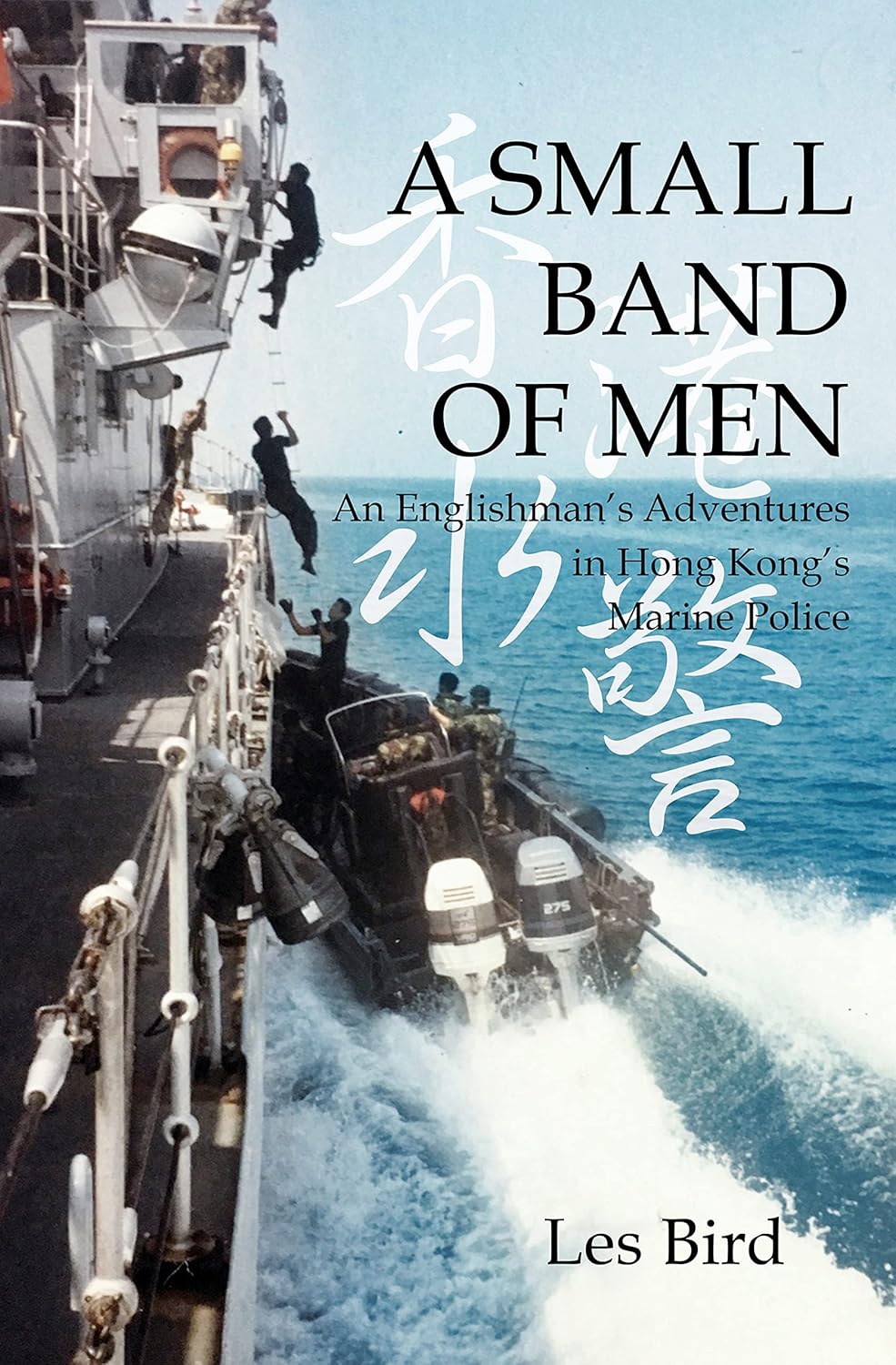
- Author: Les Bird
- Book First Published: 2020
- Publisher: Earnshaw Books
- Rating: ★★★
How our ratings work:
★★★ – Loved it. Highly recommended. Transcends interest in the location alone
★★☆ – Liked it. Recommended, especially if you’re interested in the location
★☆☆ – Didn’t like it. But may still appeal to those interested in the location
The Gist
A Small Band of Men is an entertaining, boots-on-deck memoir detailing Les Bird’s twenty-one-year career in the Hong Kong Marine Police, spanning 1977 to 1997, when the British colony was handed over to the PRC.
Bird’s story begins in 1976 when, as a 22-two-year-old drifting around the world with few prospects, he responded to a recruitment advertisement in the Daily Telegraph. He rose through the ranks to eventually command the Special Boat Unit (SBU),
“a small, elite, maritime unit comprising one hundred men and a dozen small fast pursuit craft, or rigid hull inflatable boats (RHIBs), whose primary role was that of marine counter-terrorism.”
The book provides a grounded, close-up look at a specialized occupation, focusing on maritime rescues, anti-smuggling operations, and the complex task of managing waves of refugees and illegal immigrants. Spanning the final two decades of British rule, Bird’s account captures a unique professional life during a dynamic period in the territory’s history.
The Guts
The narrative follows Bird’s career development, beginning with a dramatic “baptism” during the boarding of a ghostly, crewless foreign freighter where he had to arm himself for a potential confrontation. It’s just one of many vivid moments; other times, we ride shotgun on operations ranging from the rescue of a crashed passenger plane at the old Kai Tak airport to intercepting illegal swimmers from mainland China. For the latter, Bird’s reflections on the people he encountered add a layer of human empathy to the action; he felt a sense of pity for the illegal immigrants:
“Young people trying to break free from a life they didn’t want… I’d left home too, and chosen to come to Hong Kong. Yet here I was stopping others doing the same thing.”
In the late 1970s, Bird was posted to the Tai O district on Lantau Island. At that time, the area was a remote backwater, and Bird took up residence as the sole officer in a station that was “more castle than a police station,” featuring watchtowers, cannons, and heavy metal shutters. There was only one other Westerner in his part of the island, an Italian Catholic priest who soon became a friend. Their language of communication was Cantonese, which the villagers found highly comical.
“When the father and I dined together in one of the village restaurants, the locals would pull up their chairs so they could eavesdrop. When I got a little muddled with my Cantonese, there was always advice shouted from the crowd that had gathered at the rear. When one of us got a sentence or phrase spot on, it would be accompanied by laughter and applause.”
Why read A Small Band of Men?
I like memoirs which give a close-up look at work; they’re immersive and educational. And the grounding in reality is a welcome change from books with too much introspection and theory. Obviously, certain occupations are more appealing subjects than others; police work, for example, is more dramatic and revealing than English-teaching. Throw in the maritime element, especially in a place like Hong Kong, and you’re on track for some compelling content.
A Small Band of Men is not perfect. Some readers might find Bird’s larger-than-life commander – a domineering, hard-drinking, loose cannon of a man – too much of a presence, and wonder whether the entertaining stories featuring him might owe something to barroom retelling.
There’s also the book’s silence on Hong Kong’s fate under PRC rule. I assume that Bird still living there made it sensible to keep quiet. However, he is an excellent storyteller who captures the spirit of the place and time; most readers will come away from his adventures entertained and envious, and perhaps even cursing their own mundane jobs.
Recommended for anyone interested in police work or late-20th-century Hong Kong.
John Ross, a New Zealander living in Taiwan, is the author of Formosan Odyssey, You Don’t Know China, and Taiwan in 100 Books.
He is also the co-founder of Camphor Press and Plum Rain Press. John co-hosts Formosa Files, a podcast on the history of Taiwan, and the Bookish Asia podcast.
Support this site by buying his books.


Leave a Reply