A captivating blend of travelogue, love story and Cold War history, told through the eyes of a young writer discovering both Poland and himself.
Review by Patricia Cuni
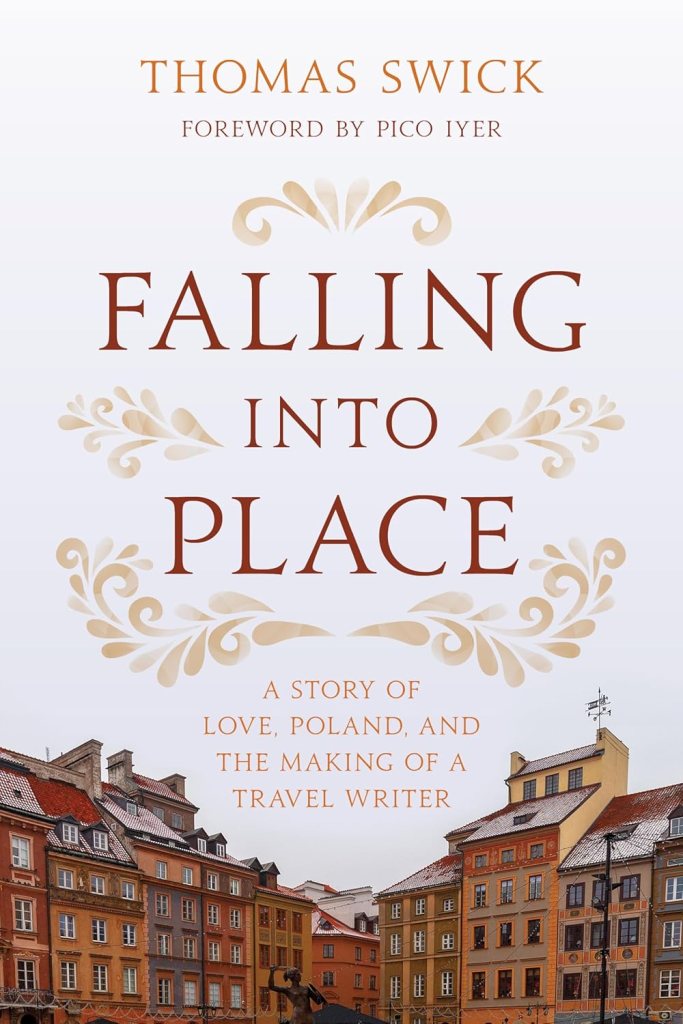
- Author: Thomas Swick
- Book First Published: 2023
- Publisher: Rowman & Littlefield
- Rating: ★★★
How our ratings work:
★★★ – Loved it. Highly recommended. Transcends interest in the location alone
★★☆ – Liked it. Recommended, especially if you’re interested in the location
★☆☆ – Didn’t like it. But may still appeal to those interested in the location
The Gist
In Falling into Place, Thomas Swick looks back on a formative period of his life: the years he spent in and around Poland during the late 1970s and early 1980s. What begins as a chance encounter with a Polish student named Hania gradually evolves into a story about love, belonging, travel, and the making of a travel writer.
Drawn behind the Iron Curtain at a pivotal moment in European history, Swick moves to Warsaw to be closer to Hania and finds himself immersed in a country on the brink of profound change. Along the way, he teaches English, mingles with diplomats and expatriates, befriends ordinary Poles, and witnesses some of the most significant events in modern Polish history, including Pope John Paul II’s first visit to his homeland and the rise of the Solidarity movement.
Part memoir, part travel narrative, and part coming-of-age story, Falling into Place explores how travel can shape a person just as much as the places they visit. It is also a deeply human account of falling in love, navigating cultural differences, and finding one’s place in a rapidly changing world.
The Guts
One of the book’s greatest strengths is the balance Swick achieves between the personal and the political. The love story at its centre provides the narrative momentum, but the real magic lies in the way he captures everyday life in communist Poland. Rather than focusing solely on headline events, he pays attention to conversations, customs, friendships, and small moments that reveal the character of a nation.
As an experienced travel writer, Swick approaches Poland with curiosity, empathy, and humility. He spends time with local people, learns their traditions, and gains insights that many foreign correspondents or short-term visitors would miss. At the same time, he moves within the international circles of embassies and cultural institutions, offering a fascinating perspective on the contrast between these worlds. One particularly memorable episode recounts how he refused attempts to be recruited as an informant during the Cold War, while others see him join a pilgrimage to Częstochowa, experience the famous New Year’s Eve blizzard of 1979, and witness history unfolding around him.
The structure follows Swick’s journey across several countries, including Poland, Greece, France, and the United States, but Poland remains the emotional heart of the story. We watch him navigate a long-distance relationship, communist bureaucracy, professional uncertainty, and the gradual development of his voice as a writer.
The book is also filled with reflections on travel writing itself. Swick frequently references writers such as V. S. Naipaul and Patrick Leigh Fermor, allowing readers to follow not only his geographical journey but also his intellectual development. One passage in particular stayed with me:
“For the correspondents, Warsaw was just one city, albeit an intoxicating one, in a career of foreign postings. And expat writers owned Berlin, London, Rome, Paris. Everyone, not just the literati, had Paris and, so the saying went, always would. Warsaw felt like mine alone. Such is the beauty of unsung places.”
The quote perfectly captures both Swick’s gift for observation and the memoir’s central appeal. He invites readers to look beyond the world’s most celebrated destinations and appreciate the places that quietly work their way into our hearts.
Why read Falling into Place?
I first read Falling into Place during a Christmas holiday in Poland while visiting family and friends. Surrounded by snow, festive traditions, and the warmth of Polish hospitality, I found it the perfect companion. It is one of those rare books that makes you eager to return to its pages whenever you have a spare moment. In fact, I struggled to put it down.
Although I have spent time in Poland and have close ties to the country, I have never actually visited Warsaw. By the end of the book, I felt an overwhelming desire to walk the same streets and neighbourhoods that Swick describes. More than four decades have passed since the events in the memoir, and the city has undoubtedly changed, but his writing made me curious to discover the Warsaw he came to love and to see what traces of it remain today.
What I loved most was the humanity of Swick’s writing. His affection for both Hania and Poland shines through every chapter without ever becoming sentimental. You can tell he is an experienced travel writer, but what impressed me was his empathy. He approaches people with genuine curiosity and respect, creating a portrait of Poland that feels nuanced, affectionate, and deeply authentic.
The book remains highly relevant today. At a time when discussions about borders, identity, democracy, and East-West relations continue to shape Europe, Swick’s observations offer valuable historical context. Yet this never feels like a history lesson. Instead, it is the personal story of a young man discovering the world as he witnesses one of the most important periods in modern Polish history from the unique perspective of a foreigner living in the country.
I would recommend Falling into Place to anyone interested in Poland, Cold War Europe, or travel writing. But its appeal extends far beyond geography. Readers who enjoy memoirs about personal growth, cultural immersion, and the transformative power of travel will find plenty to admire here. Above all, it is simply a pleasure to read.

Patricia Cuni is a Spanish journalist and travel writer based in Edinburgh.
She runs Mad About Travel, sharing Scotland’s hidden gems with a Spanish-speaking audience. Twice named among Scotland’s Top 100 Women in Tourism, she is Marketing Manager at The Real Mary King’s Close.
 The Travel Memoir Review
Leave a comment